Learn more

Learn more
Learn more
Ideal Office Humidity: Regulate Indoor Air Quality with Plants
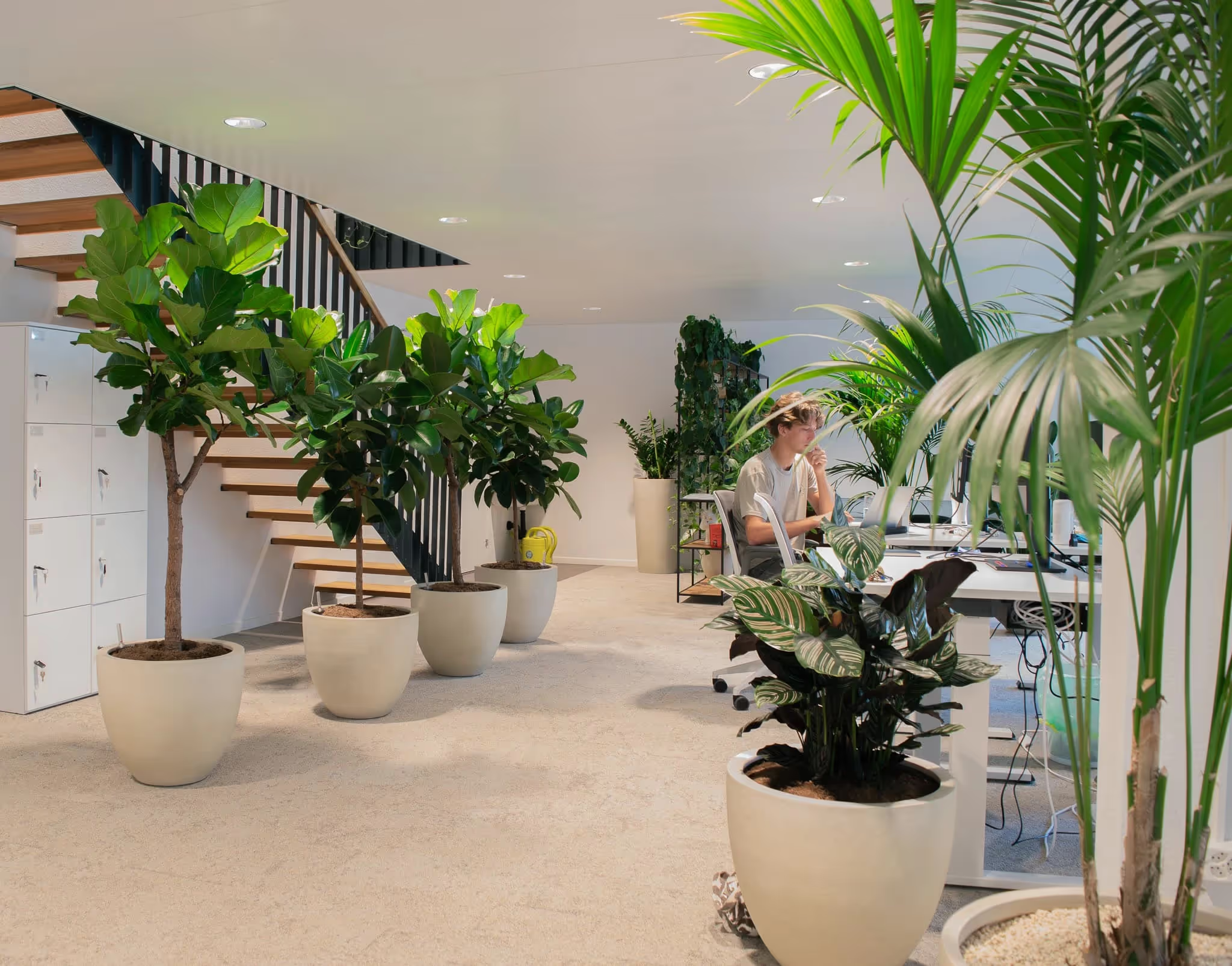

An overlooked factor in office life
Most offices pay attention to temperature and light, but rarely to humidity. Yet it shapes how people feel every day: dry air irritates skin and airways, while overly humid air encourages bacteria and mould. Both affect wellbeing and focus. This article looks at the humidity range that works best for offices and how office plants can be used as a natural way to regulate it.
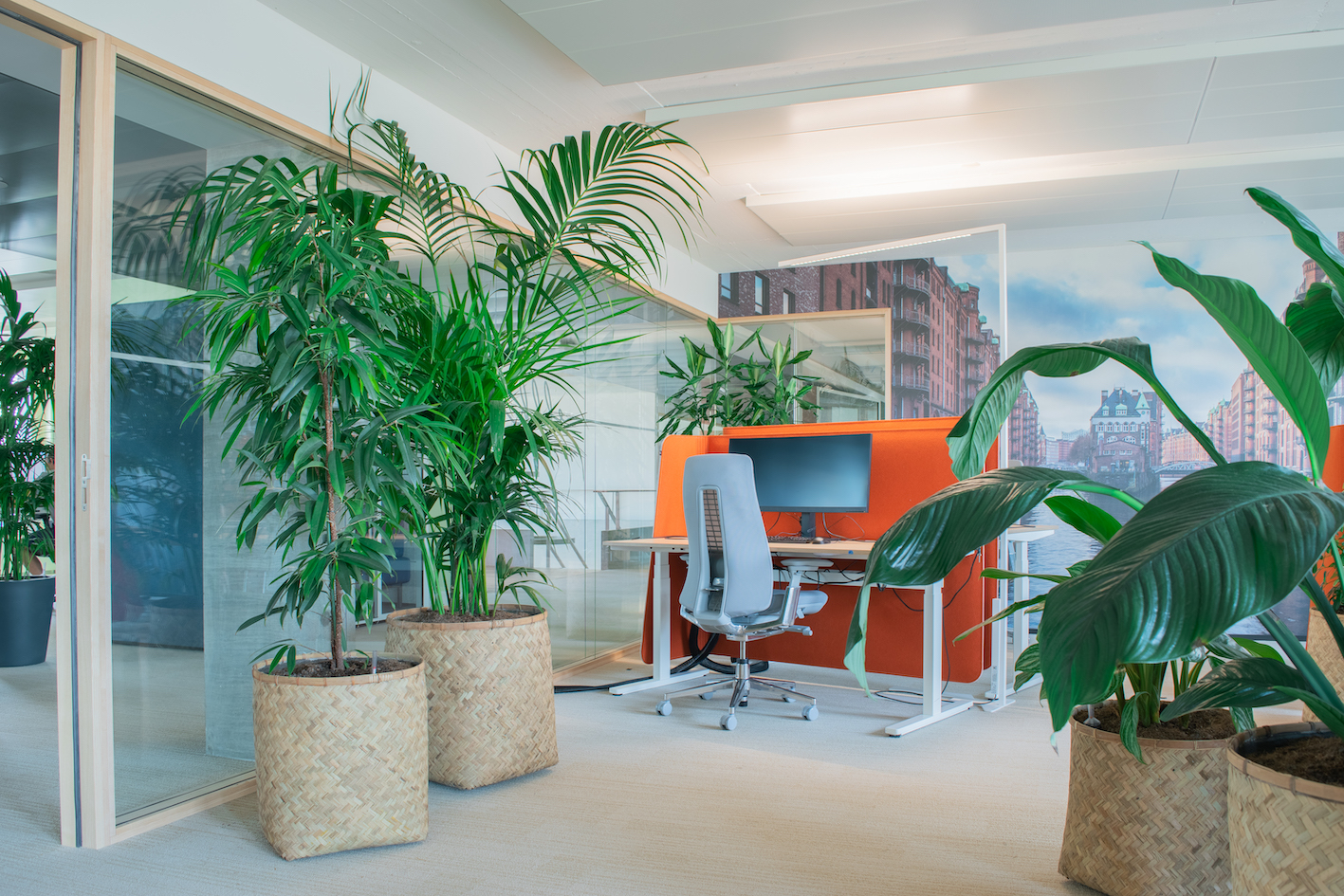
Understanding and regulating humidity in the office
What is humidity and relative humidity?
Humidity describes the amount of water vapour in the air and is usually expressed as a percentage. Two terms are worth distinguishing here.
Absolute humidity is measured in grams per cubic metre. It shows the actual amount of water vapour in the air and stays constant regardless of temperature.
Relative humidity describes the ratio between the current water vapour content and the maximum the air can hold at a given temperature. This is the value used in indoor air monitors and the one that matters for office design.
Why does relative humidity matter in the office?
Monitoring humidity in the office is a simple but effective way to support employee wellbeing. Research suggests that balanced humidity can reduce stress and support concentration, two factors that matter for a productive workday.
Alongside other indoor air parameters, humidity also affects respiratory and skin health. Some studies point to low humidity as one of the main contributors to atopic eczema. Dry air also draws moisture from the skin, which can speed up the ageing process.
When humidity drops too low, it can lead to a dry throat and stronger allergy symptoms. When it climbs too high, it encourages bacteria and mould growth, raising the risk of seasonal illness and, in turn, more sick days in the office.
Does outdoor humidity affect indoor humidity?
Yes, though indirectly. Cold outdoor air with high relative humidity loses much of that moisture once it enters a building and warms up. The resulting warmer air has a noticeably lower relative humidity, which can leave indoor air feeling dry.
Moisture and air constantly move between inside and outside through windows and doors. Opening windows during rain or snow can raise indoor humidity for a short period.
What is the optimal humidity range for an office?
Optimal range: 40 to 60 percent. Within this range, the risk of dry skin, respiratory irritation and mould growth is lowest. This is the standard for healthy office environments in Switzerland and Germany.
Acceptable range: 30 to 70 percent. Values in this range are workable for most indoor spaces, even if not ideal.
Critical range: below 10 percent or above 90 percent. These extremes are considered a health concern and can contribute to headaches and general discomfort.
Worth keeping in mind: the right range can shift slightly depending on location, season and heating period.
How do other air parameters interact with humidity?
Higher relative humidity can encourage the release of TVOCs (volatile organic compounds), particularly formaldehyde. This mainly affects new or recently renovated offices where building materials have not yet fully cured.
Temperature and relative humidity also move in opposite directions: as temperature rises, relative humidity falls if absolute humidity stays the same.
How do office plants help regulate humidity?
When opening windows or installing a new HVAC system are not options, office plants offer a natural way to stabilise humidity. Through transpiration, they continuously release moisture into the surrounding air, counteracting overly dry conditions.
Plants draw water up through their roots and release part of it through their leaves. This natural cycle helps maintain a more even humidity level in the office and makes office plants a quiet but effective part of a biophilic design concept.
The top four office plants for raising humidity
Schefflera arboricola compacta. The schefflera, also known as the dwarf umbrella tree, is a proven choice for green walls. It tolerates lower humidity well, and through transpiration it actively helps stabilise humidity levels in the room over time.
Caryota mitis. The fishtail palm is hardy and adapts well to different room conditions. Its glossy, sturdy leaves keep their colour even as humidity shifts, while also trapping fine dust particles.
Ficus lyrata. The fiddle leaf fig offers strong air purifying qualities. We use it often in our plant concepts because it brings elegance together with a tropical feel.
Kentia howea. The kentia palm brings a calm, elegant presence to any plant arrangement with its palm like growth. It is also low maintenance and hardy, making it a practical choice for office environments.

The optimal range is between 40 and 60 percent. Values between 30 and 70 percent are also acceptable, even if not ideal.
Overly dry air can irritate skin and airways, worsen allergy symptoms and speed up skin ageing. Below 10 percent relative humidity is considered critical.
Above 70 percent encourages bacteria and mould growth, raising the risk of seasonal illness. Above 90 percent is considered a health concern.
Yes, indirectly. Cold outdoor air loses relative humidity as it warms up indoors, which can leave the air feeling drier. Opening windows at the right moment can help offset this.
Plants release moisture into the air continuously through transpiration. This helps maintain a more even humidity level, without any technical intervention.
Schefflera arboricola compacta, Caryota mitis, Ficus lyrata and Kentia howea have all proven effective. Each works well in an office setting and fits easily into an existing greening concept.