


Philodendron scandens
- Dec 11, 2025
- 4 min read
Why the Philodendron scandens makes a great office plant
The Philodendron scandens brings a quiet sort of confidence into an office space – the kind that doesn’t announce itself loudly, yet commands attention through form, texture, and generosity of foliage. Its heart-shaped leaves shine with a soft green tint that feels instantly soothing, capturing the timeless appeal of tropical understory plants while staying elegantly compact at 40 centimeters in width and a graceful 140 centimeters in height.
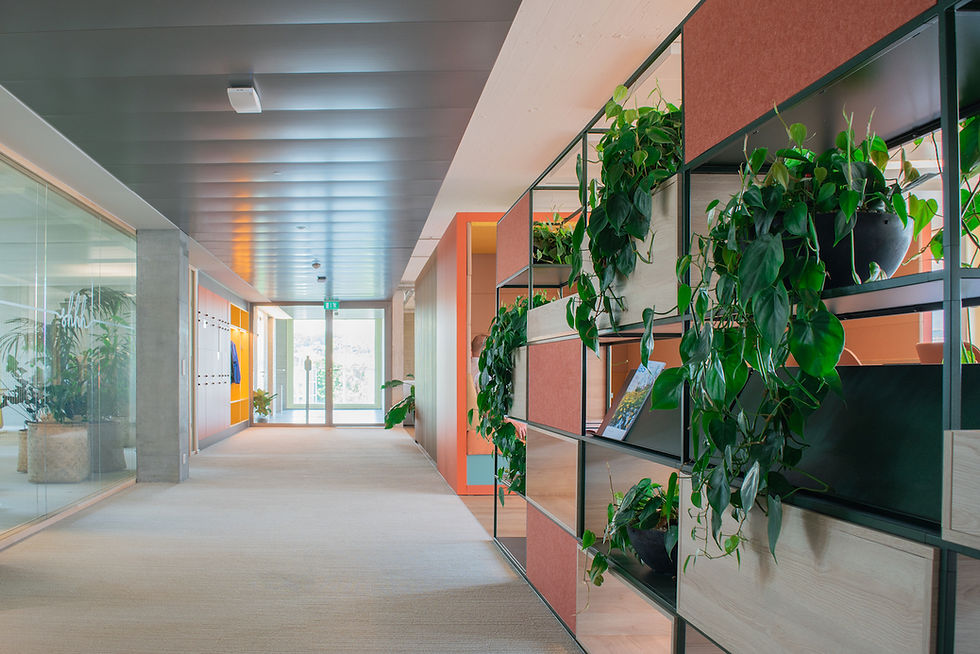
In modern workspaces, where visual calm is increasingly becoming a design priority, this plant steps in as a natural mood balancer. Its trailing or climbing form adapts beautifully to shelves, partitions, or elevated planters, giving designers plenty of room to play with verticality without overwhelming a room.
The species handles typical office light conditions remarkably well. As a plant native to the dim understory of Central and South American rainforests, it performs reliably in environments dominated by indirect or filtered light. Temperature fluctuations from air conditioning or heating are typically well tolerated, provided no drafts are involved.
Another quiet advantage: no pollen and therefore no dust-clouding surprises. The Philodendron scandens grows steadily but discreetly, avoiding the sudden expansion some tropical species show. Its shape makes it an excellent candidate for soft space division, subtly guiding the flow inside open-plan layouts without closing anything off. All this adds up to a plant that harmonizes with the rhythm of office life — calm, adaptable, and visually delightful.
Under what conditions does the Philodendron scandens thrive?
The Philodendron scandens originates from the shaded rainforest floors of Central and South America. There, it climbs tree trunks or cascades down from branches, benefitting from consistent humidity and indirect light that filters through dense canopies. This natural background explains why the species adapts so well to low-light urban workspaces and indoor conditions with controlled climates.
Indoors, a partially shaded location suits the plant well. Its leaves maintain their rich green tone under moderate light levels, and the plant’s overall vitality benefits from environments that mimic its tropical origins.
Maintenance
Watering
The plant should be kept evenly moist by ensuring that the substrate does not fully dry out. It should be ensured that excess water can drain freely to maintain root health and avoid waterlogging.
Fertilising
The plant should be fertilized during active growth phases with a balanced nutrient supply. It should be ensured that over-fertilization is avoided, as this can impair leaf development and root function.
Cutting
Cutting should be done to guide growth or maintain shape. It should be ensured that clean tools are used to prevent infections and that cuts are made in a way that supports structured vine development.
Other Care
High humidity conditions should be maintained to reflect the plant’s natural habitat, and it should be ensured that leaves remain clean to support efficient photosynthesis. If aerial roots develop, these should be allowed to remain, as they contribute to overall growth stability.
Oxygen at Work’s all-inclusive maintenance package ensures that all these steps — from watering cycles to nutrient balancing — are carried out expertly and consistently. Clients benefit from lush, healthy plants without needing to manage any care themselves. |
How much water is evaporated by the Philodendron scandens?

Georges - Data Project Manager
“Using research, real life tests, and office air quality data, we approximate the effect of different plant species. Of course, the actual effect can vary depending on things like room conditions and the plant’s overall health.”
The Philodendron scandens might be compact, but its contribution to indoor air quality is anything but small. With a total leaf surface of 0.669 square meters, the plant participates actively in transpiration processes. On average, it evaporates 1.2 liters of water per month, subtly increasing local humidity and helping stabilize the microclimate in enclosed spaces.
To understand this in context, consider a typical Howea forsteriana of 1.90 meters height and 0.7 meters width, which evaporates around 2.1 liters of water monthly. While the Philodendron scandens is smaller, its performance relative to size is noteworthy and makes it a valuable element in offices where multiple strategically placed plants create a balanced environment.
Stats
Height: 140 cm
Width: 40 cm
Leaf surface: 0.6 m²
Monthly water evaporation: 1.2 l
These measured plant values highlight the species’ subtle but important contribution to improved indoor air quality. Oxygen at Work uses data-driven methodologies to evaluate real plant performance, ensuring every plant concept is backed by scientific insight rather than assumptions.
FAQs about the Philodendron scandens
Is the Philodendron scandens suitable for low-light offices?
Yes, the Philodendron scandens performs well in low to moderate light environments, mirroring its natural rainforest understory habitat. This makes it a reliable choice for offices without direct sunlight.
Does the Philodendron scandens grow quickly?
The species displays steady, moderate growth, developing trailing or climbing vines. Under favorable indoor conditions, it can extend significantly, making it ideal for shelving or vertical accents.
Is the Philodendron scandens safe for office environments?
The plant does not produce pollen and grows quietly, making it well suited for shared workspaces. As with many indoor plants, it should not be ingested.
How tall does a Philodendron scandens get indoors?
In office environments, it typically reaches heights or lengths of around 1 to 2 meters, depending on the support structure. Its compact width keeps it visually light even as it elongates.
Does the Philodendron scandens improve indoor air quality?
Its transpiration rate contributes to a more stable indoor humidity level. With 1.2 liters of monthly water evaporation, it plays a measurable role in creating a more comfortable office microclimate.


