


The ideal office humidity: values, guidelines (DE & CH) & biological indoor climate

Brought by Eloïse

The relative humidity in the office is much more than just a number on a sensor. It is the invisible link between modern architecture and human biology.
For facility management, the first golden rule is: the ideal humidity in the office is between 40 and 60%. While conventional climate systems often struggle to keep this air quality stable during external temperature fluctuations, practice shows that a static system alone reaches its limits. At Oxygen at Work, we view spaces as living ecosystems where the physiology of the plant interacts directly with human performance.
Why humidity determines the vitality of your team
Poorly regulated humidity is not just a disruptive factor, but triggers a physiological chain reaction that deeply affects health:
-
Weakened mucous membrane barriers: If the humidity drops too much, the tear film evaporates (dry eyes) and the mucociliary clearance of the airways is impaired. The natural protective function against pathogens decreases.
-
Increased virus transmission: In dry air, viruses and aerosols remain suspended longer, which significantly increases the risk of infection in open spaces (Guarnieri et al., 2023).
-
Loss of cognitive resilience: An unbalanced indoor climate measurably leads to fatigue and poor concentration.These are symptoms that contribute significantly to the so-called "Sick-Building-Syndrom".
With that in mind, general regulations recommend that the relative humidity level staays between 40-60%.

A Look at the Real World: Our Indoor Climate Experiment with George
Theory is all well and good, but real data is better! To show just how much of a measurable difference plants really make in everyday office life, we conducted an exciting experiment with George. In a separate blog post, we detail how air quality and humidity in one of our meeting rooms changed over the course of a week—once with no plants at all and once with strategically placed greenery. The results impressively demonstrate how quickly plants can restore a dropping humidity level, even when the outside temperature exceeds 30 °C. Curious about the exact figures and the data comparison?


Regulatory guardrails: Guidelines for Germany and Switzerland
To protect health in the workplace, authorities define clear corridors.
Germany (ASR & workplace standards):
The Technical Rules for Workplaces (ASR A3.6) set the pace. If the humidity drops permanently below 30%, preventive measures must absolutely be taken.
Switzerland (SECO & SIA):
The State Secretariat for Economic Affairs (SECO) and the SIA standards recommend a relative humidity between 40% and 60%. The EPFL also concluded in studies that this range optimally supports human homeostasis.
The biological paradox: When heat dries out the office air
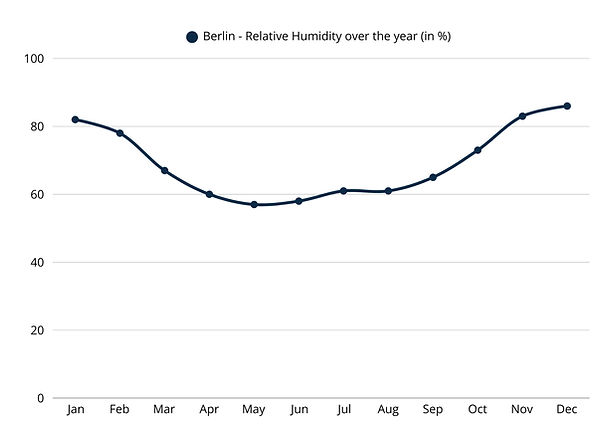
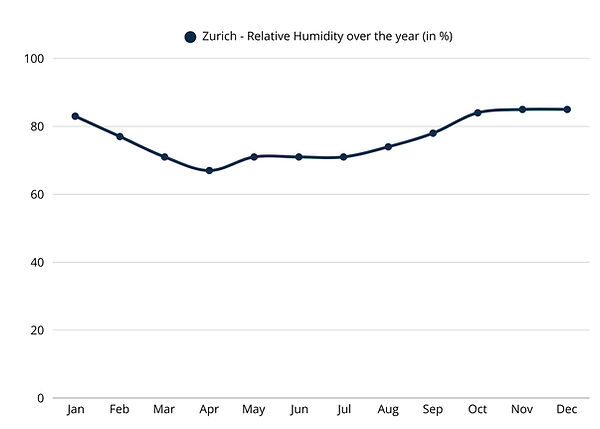
A look at the climatic data of Zurich or Berlin reveals a major challenge: especially in the winter months, indoor humidity drops drastically. As soon as cold outside air flows into the building and is heated, it physically loses its ability to bind water. This is exactly where active humidity management becomes essential.
Humidity over the year - Berlin
Humidity over the year - Zurich
Zurich - City
Zurich - Oxygen at Work, Office


The Swissgrid Office -
A Prime Example for A Successful Greening
Swipe left to see a before / after of one of our projects!


Transpiration: Regenerative technology instead of technical symptom treatment
While mechanical humidifiers are often high-maintenance isolated solutions (power consumption, noise, mold risk), we use the natural technology of the plant world. Through the process of transpiration, plants can adaptively release about 90% of the absorbed water back into the environment. Plants are natural, bidirectional climate regulators. In summer, when hot outside air heats up the room,we were able to prove in our indoor climate experiment with George that targeted greening stabilizes a dropping humidity level and cools it. Through our sensor technology, we make this biological effect visible in real-time in the air dashboard.
But plants also unfold their effect in winter: when cold outside air is heated and strains our mucous membranes as extremely dry heating air, they act as natural humidifiers. A renowned study by the Agricultural University of Norway (Prof. Tove Fjeld) proves that greened rooms measurably increase humidity and reduce typical winter complaints such as dry airways by around 30%.
The conclusion: Whether summer heat or dry winter air - plants regulate the humidity all year round to a healthy, revitalizing level.
3 Botanical powerhouses for a healthy indoor climate
Some plant species are particularly efficient at releasing water into their surroundings:
Kentia Palm (Howea forsteriana)
An architectural classic whose sprawling fronds act as natural evaporation surfaces and simultaneously filter pollutants.

Spathiphyllum (Peace Lily)
A core element of biophilic design. It not only generously provides moisture, but also filters VOCs (volatile organic compounds) such as formaldehyde from the air.
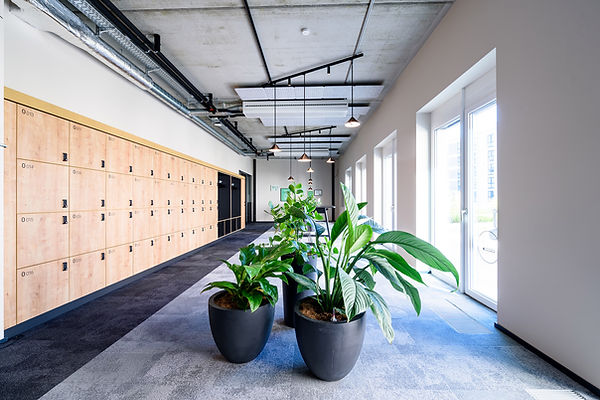
The Spathiphyllum is on the right side of the picture.
Rubber Tree (Ficus elastica)
With its large leaves, it ensures a high water release. It is robust and guarantees continuous revitalization in highly frequented zones.
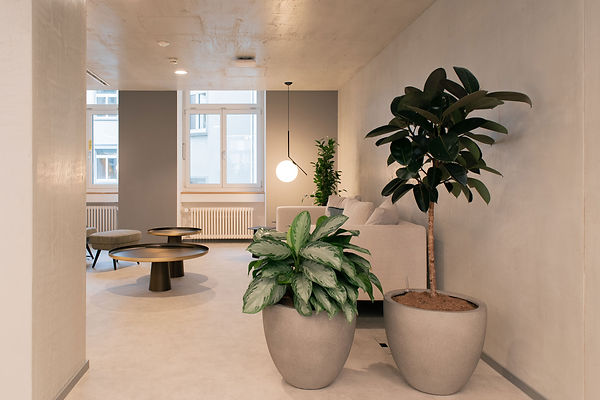
The Ficus elastica is on the right side of the picture.
Conclusion: Vitality is a management decision
Optimizing office air is an investment in your company's most important resource. With our holistic approach, we take full responsibility for this vitality. We do not deliver decoration. We guarantee an indoor climate that breathes.
FAQ: The most frequently asked questions about office humidity
When is the office air too dry?
As soon as the values constantly drop below the limit of 30 to 40%, the air is considered too dry and can trigger health complaints.
What is the best way to measure humidity?
The most reliable way to do this is with a digital hygrometer or indoor climate sensors, ideally positioned in the middle of the room where employees work and breathe.
Is regular ventilation sufficient to increase humidity?
No. In winter, ventilation with cold outside air can paradoxically cause the relative humidity in the heated room to drop further. Smart greening or targeted humidification are essential here.